Customer request
A new Lead can remain open until it is ready for an Estimate, Service Call or direct Work path.
Owner-operator case study
This is a qualitative account from the business that helped shape Osrilo. It explains the operating problems and workflow changes without inventing a time-saved percentage, revenue lift or customer count.
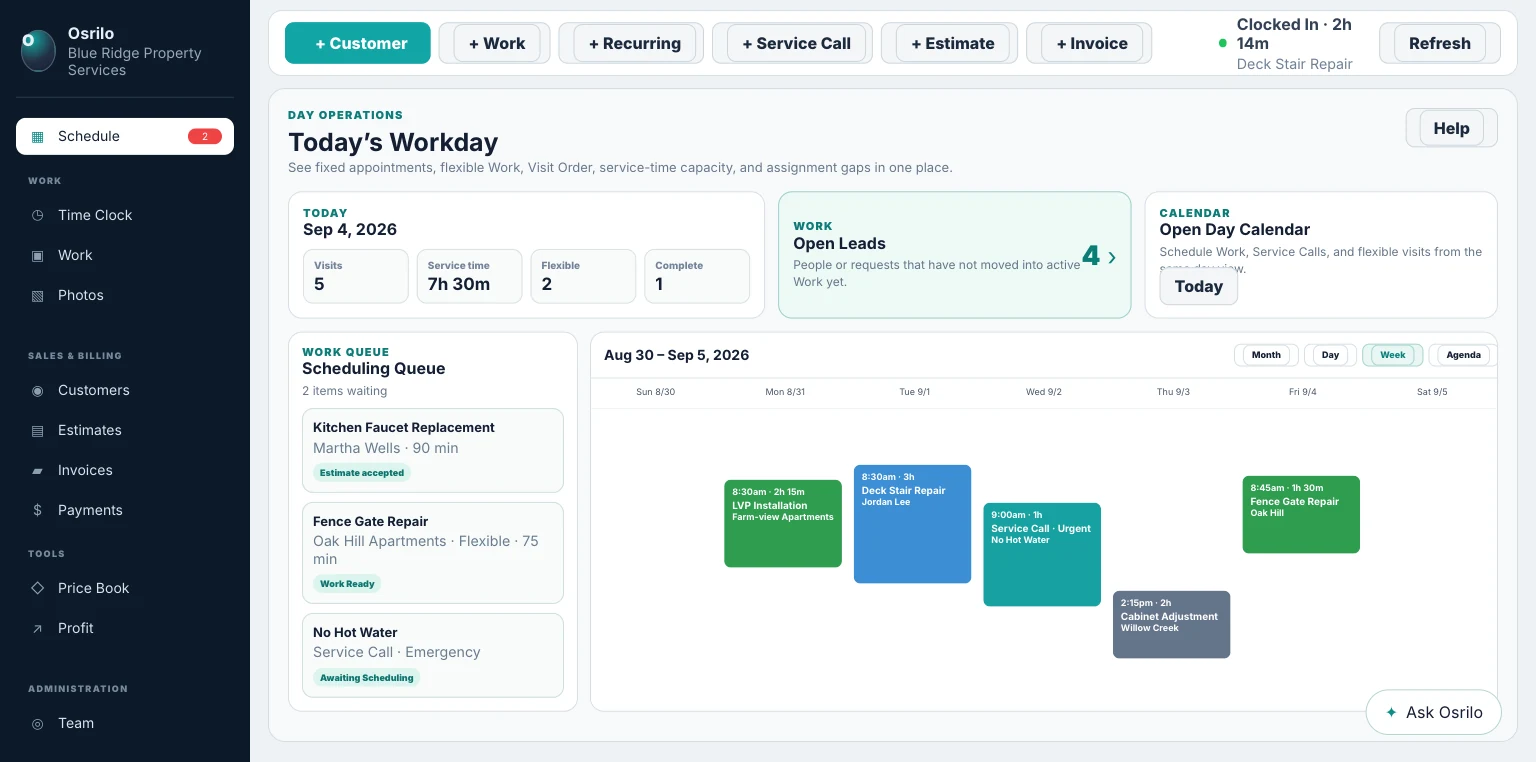
Anderson’s Home Repair is an owner-operated home-repair business. The workday includes more than completing jobs. New customer requests need an answer. Some requests need an Estimate. Accepted Work needs a date. Flexible jobs need a sensible place in the day. Finished Work needs an Invoice. Unpaid documents and follow-up cannot depend only on memory.
The problem was not that those facts were impossible to record. The problem was that they could live in separate places: text messages, notes, a calendar, document drafts and the owner’s head. A disconnected system still leaves the owner responsible for reconstructing what happens next.
Osrilo gives the business one connected path: capture the customer and Work, prepare an Estimate when needed, record the customer decision, move ready Work into scheduling, record actual field execution, create the Invoice and keep payment status attached to it.
That does not remove owner judgment. It gives the judgment a clear record and a visible next action.
A new Lead can remain open until it is ready for an Estimate, Service Call or direct Work path.
Flexible Work can carry a date and expected duration without inventing an exact customer appointment.
The Estimate and Invoice stay attached to the Work and Customer instead of becoming unexplained files.
Scheduled time stays separate from actual start and finish, so the history reflects what happened.
Recurring plans can produce real visits rather than acting as a detached reminder list.
Schedule, Inbox, Work filters and connected status reduce the number of loose ends the owner must reconstruct.
“The biggest change for me is not having to decide from scratch what needs attention every time I open the business. The record itself can show me where the Work is.”
A useful case study should distinguish firsthand experience from a measured result. Anderson’s Home Repair has experienced clearer organization and less dependence on memory, but Osrilo has not published a controlled measurement of hours saved, revenue gained or missed appointments reduced.
Start the 14-day Solo trial. No card required.